This week, the Dow Jones Industrial Average (^DJI) gained more than 0.5%, while the S&P 500 (^GSPC) and the tech-heavy Nasdaq Composite (^IXIC) also rose around 0.5%. All three major averages concluded the week with gains, owing largely to easing concerns over US-China trade tensions and credit worries.
President Trump signaled that talks with China are on track, relieving investor concerns over an escalation in trade disputes. The President also said that the threatened 100% tariffs on Chinese goods from November 1 would not be a sustainable level for both economies.
On the banking front, US regional bank stocks recovered from significant losses following positive earnings updates from lenders such as Truist Financial Corp., (TFC), Huntington Bancshares (HBAN), and Fifth Third Bancorp (FITB). Earlier in the week, bank stocks had taken a hit on news of loan-related problems at regional lenders, sparking concerns over creditworthiness.
Key gainers for the week included Zions Bancorp which climbed nearly 6% on Friday following a market downgrade earlier in the week due to loan-related issues. Investment bank Jefferies, which experienced a downturn due to its exposure to the collapsed auto parts retailer First Brands, also closed up 6% after an upgrade from Oppenheimer.
Despite a turbulent week marked by US-China trade relations and the prospect of a prolonged US federal shutdown, all three major indexes finished the week higher. The S&P 500 rose 1.7%, fueled by a strong start to third-quarter earnings. The Dow added 1.6% for the week, while the Nasdaq gained 2.1% over the same period.
Looking ahead, third-quarter earnings are set to continue with expectations for the S&P 500 to report above 13% growth. Investors are also bracing for key inflation data with the September consumer price index scheduled for release. However, predictions suggest a further quarter percentage point rate cut at the Fed’s late October meeting.
Persisting US-China trade tensions are still a factor, with high-level discussions planned for October 31-November1 at the APEC Economic Leaders’ Meeting for 2025 in South Korea.
In summary, this week saw gains across the board despite uncertainties over trade disputes and credit market fears.
The stock market ended lower this week led by declines in bank stocks on concerns about bad loans, losses in the Dow Jones were particularly significant with a drop of 301.07 points, landing at 45,952.24. The S&P 500 landed at 6,629.07 with a 0.6% drop, while the NASDAQ Composite was down 0.5% to reach 22,562.54. Regional banks such as Zions and Western Alliance saw considerable falls, both due to bad loans. Zions fell 13%, while Western Alliance dropped 11%.
Despite these losses, some financial experts advise that this may pose a good buying opportunity when stocks are relatively cheap. Concerns about loose lending in the banking industry have been influenced by recent bankruptcies in the auto industry; specifically, companies like First Brands and Tricolor Holdings. This potentially exposes bigger lenders like JPMorgan and Wall Street finance company Jefferies to significant losses. The stocks of the latter company decreased by 10%, taking its monthly losses to 25%.
On the trade front, the stock market reacted to President Trump’s threats of increasing tariffs on China and his later decision to walk back on the threats. If a significant escalation in the trade war occurs, analysts predict an 11% market fall into correction territory.
In tech, the rise of AI-related stocks is a double-edged sword as some experts caution against a potential dot-com-like bust due to high valuations not being able to support the market indefinitely. Current valuations could eventually face a reality check. However, Wall Street’s dominant view is that the run-up in AI stocks is just the beginning of a long-term trend.
Inflation is beginning to rise and hiring has slowed, while trade has slowed due to higher tariffs, thus causing some concern over stagflation. Consequently, the Federal Reserve’s recent rate-cutting campaign may yield to concern over inflation. However, on the positive side, potential geopolitical easing in Ukraine and the Middle East, as well as lower oil prices could contribute to the easing of the inflation burden.
Sources:
- Stock market today: Dow, S&P 500, Nasdaq notch weekly wins after volatile week as Trump signals China talks back on track
 Stocks close higher as bank credit worries, China trade tensions ease
- Stock market today: Dow drops 300 points, S&P 500, Nasdaq slide as regional bank woes hit markets
- Stock market today: S&P 500, Nasdaq rise in choppy trade as Wall Street weighs earnings, China tensions
 Wall Street gears up for more earnings next week, with CPI data coming too
 Stocks close lower, with Dow dropping 300 points, as fears about bad loans in banking industry grow
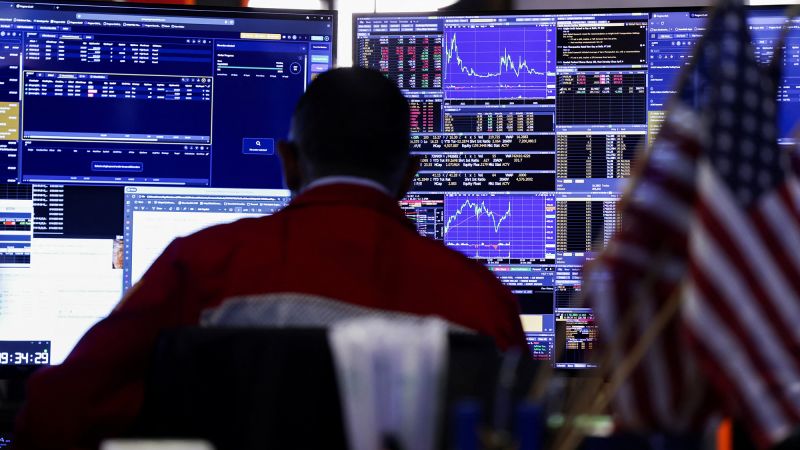 What will happen next in this topsy-turvy stock market? Choose your own Wall Street adventure!